Thursday, July 15, 2010

Roommates - Process Analysis

Saying that I HATE process analysis might be a little unfair. I definitely don't love it, though.

My professor is decidedly against using research in our papers (as he doesn't want to grade MLA citations until he has to, as far as I can tell), so picking a topic meant that I needed to stay in the realm of the day-to-day. Bad roommates are, I think, a universal constant, but I decided that my experiences were only the tip of the iceberg. I turned to reddit for additional insight, and got some really interesting stories, though ultimately I decided to keep it mellow.

---

Roommates


Reaching adulthood and striking out on your own can be at once intimidating and exhilarating. Leaving the nest -- so to speak -- is an important coming-of-age ritual and a vital part of the development process; this is especially true in a society, such as ours, that so highly values individual capability and independence. Making your own way in the world at such a young age can be difficult, though, and it can be hard to gain any footing on your own. It is precisely this reason that many -- indeed, most -- of us seek a companion to help us as we take our first steps away from home. Be it a friend, a lover, or a total stranger, we seek a roommate for the stability we need to succeed on our own. A roommate can, however, be as much a curse as a blessing; a good roommate will ease your financial burdens and provide quality company and support, while a bad roommate is fully capable of the opposite: destroying you financially, eroding your confidence in humanity, and causing immeasurable grief and anxiety. With so much at stake, it is imperative to know how to successfully detect a troublesome roommate before the situation escalates beyond control.

While you should never judge a book by its cover, first impressions are crucial to filtering out the good from the bad. Every single day we rely on our first impressions to help us make critical decisions about many aspects of life. Our subconscious is adept at recognizing a huge number of factors that help us form a preliminary judgment which, while sometimes inaccurate and rarely complete, should not be ignored. When meeting a potential roommate for the first time, it is important to be aware of our first impressions and to take them into account when evaluating whether the person will be a good fit. Both parties should treat the meeting as a job interview: pay close attention to the entire presentation, taking stock of his or her attire, manner of speech, and any issues that the person presents as a priority. Beware of anything about your prospective roommates that could pose a potential problem, such as their reasons for looking for new lodging, their attitudes towards partying, their employment status, and even the specific jobs they work. It may seem cruel to simply follow our instinct in passing judgment -- and it can be difficult to say no to someone in need who is in a similar situation -- but being aware of these initial red flags can allow you to prevent a bad situation from ever occurring.

Unfortunately, much of the time we do not have the luxury of knowing a bad roommate before we are in a living situation with them. For this reason, we must know how to recognize a problem as it manifests, before it gets out of hand. Cleanliness, for example, is an important factor. An unclean living space can play host to an entirely new set of problems, from negative social implications to potential health and safety hazards to pest control problems and even, in extreme cases, structural damage and degradation. Mountains of dirty dishes, scattered collections of long-forgotten food, significant clutter in common areas, trash buildup, and mold buildup are all signs of a bad roommate. While any one or two of these problems can, with some patience, be worked through, combinations of these symptoms will often mean that a roommate is incorrigible. The insidious buildup of filth can be easy to miss until it's too late, so on this more than anything we must remain vigilant.

Pets, too, can be cause for concern, and require a certain amount of attention. Many animals can be just as troublesome as a bad roommate, or worse, as they cannot be held responsible or be reasoned with for their actions. Recognizing a problem animal before it becomes a problem can be difficult, however, and in many cases the safest course of action is to avoid roommates with pets or, at the very least, to filter the kind of pet that you will allow. Smaller animals, for instance, are easier to maintain control of and clean up after. Some animals will help you determine the quality of a potential roommate's character: any well-trained animal, such as an obedient dog, will generally indicate that the owner is a capable one; other animals, like fish, require a fair amount of responsibility to maintain, and are likely to belong to a relatively low risk roommate (do not hesitate to ask, however, how long the fish have been alive in the owner's care, as they are not difficult to replace). Other animals can be a liability and should be avoided at all costs, regardless of the apparent capability of the owner. The great poet Lord Byron kept a tame bear in his dorms at Cambridge, though one would likely be wary of actually living alongside someone so "mad, bad, and dangerous to know."

It is said that you will never truly know a person until you have lived with them. And while we are more likely to overlook the transgressions of our friends or loved ones, the desire to preserve our relationships means that it is all the more important that these people are not exempt from scrutiny. Everybody has a number of annoying little habits that can, with some patience, be overlooked or worked through, but even some of the most assertive people can allow their tolerance to get the best of them. Early detection is key, as what may begin as a bit of unnecessary clutter, left unchecked, can progress to a nightmarish collection of filth. Knowing how to recognize the difference between an annoyance and a truly bad roommate is the key to taking control of a situation or, when possible, avoiding a problem altogether.

Tuesday, May 25, 2010

You Get What You Need - Narrative

Summer term might have been a mistake. I wasn't thinking clearly when I signed myself up for four classes (out of pocket, I might add) in addition to a full time work schedule. Not all is doom and gloom, though; I've finally stretched my literary muscles for the first time in ages and have been given the opportunity (read: forced) to do some academic writing again.

Fodder for the blog.

This week's assignment was to write a narrative, 700-1000 words, detailing a true story with a lesson or moral. I've always preached that morality is inherently relative, but we've all learned a thing or two from time to time. I decided that in this case I would write a meta-essay, detailing the difficult process of selecting an essay topic.

To be fair, I spent much less time coming up with the topic than I did deciding whether I'd be blacklisted for it.

Enjoy.

---
"You Get What You Need"

"It doesn't have to focus on some life-changing epiphany, just any time where you learned something. I think everyone can think of at least one time where you learned something." For the second time in as many years I found myself seated in an English Composition class. My credit didn't transfer but I couldn't wait any longer to find out why; I had made a plan to graduate and I wasn't about to put that off over some low-level English class. Besides, I'd earned this credit once before, how hard could it be? So there I sat, two weeks into the course, taking down the first writing assignment.

It wasn't a particularly difficult assignment. In fact, it should have been easy. A few hundred words telling a story with a lesson and I could call it a week, it would be smooth sailing. He was right -- the professor -- to suggest it would be a simple matter; after all, I had my share of stories and it was only a matter of choosing.

At the end of class I waited for most of the other students to leave before packing up my things. I made my way down the hallway, empty and bleak in only the way that fluorescent lighting can achieve, and pushed my way out of the of the glass doors into the the night. Fresh air met my nostrils and twirled playfully across my face and I slowed my walk, gazing at the stars as I ambled across the parking lot. A steady stream of light appeared nearby and moved slowly and deliberately out of sight, the red and gold orbs of endlessly advancing cars. I reached my van and fumbled with my keys before climbing up to my perch and lighting the headlights. A quick turn of the wrist and the engine roared to life. "A few hundred words," I thought; "This will be easy. I'll start it tomorrow." The vehicle lurched forward, and I was swept off with the river of light.

Three days passed -- long, tiresome, unproductive days -- before I turned my attention back to the assignment. It was late on a Friday night and I was staring at my computer monitor. The word processor filled the screen and the harsh white glare lashed out at my eyes. The cursor stood at the head of the page, blinking, austere and immovable. The page was empty. One letter at a time, I typed my name. The cursor followed suit, moving reluctantly with each additional character. I sighed and leaned back in my creaky office chair, swiveling to and fro. The low hum of my apartment's air conditioner filled the room as I wracked my brain for something, anything, to write about. Outside, the rumble of thunder orchestrated a symphony of car alarms in the apartment complex. I groaned and sprang to my feet, stepping onto the porch in time to watch the first droplets of rain.

Sunday morning, she sat across from me on the couch. "So you just have to come up with a story with a moral? And you can't think of ANYTHING?" Tendrils of steam reached up from a mug of coffee and mingled with loose strands of hair. My roommate.
"It's not that I can't think of anything at all; I've got plenty of stories, I just can't think of anything that I really WANT to write about."
"If it's taken you all week, why can't you just pick something and get it out of the way?"
It had been five days and I still hadn't even decided on a topic. She was right, but I just wasn't satisfied with my options. My chair creaked as I leaned back. "It's just..." I bit down on the pen cap that I had been playing with and leaned forward, creaking again as my elbows came to rest against my knees. "I mean, I don't want to write anything too cheesy, but how many stories can I just tack an obvious moral to? I can't think of any stories that wouldn't feel forced. Or at least appropriate for school."
Elaine stood to leave, but paused before turning away. "It's just an essay. Stop trying so hard and just write it."

Later that afternoon I left for work and pushed the assignment from my mind. I still had a little over a day to decide on a topic; the words, I thought, would follow close behind. In the evening I stepped outside for a break, some fresh air to clear my head. The sky was beginning to darken and the clouds were changing hue, and my mind scrambled to find something to write about as I took a seat on a bench along the sidewalk. For all of the stories I thought I had, I could conjure nothing. Surely I've had plenty of lessons, but aside from cheap anecdotes and forced metaphor, what could I really write about? I could never turn in a story of some sordid romance, or a tale of unrequited love, and be taken seriously; could I? I stared up at the sun as it dipped low in the sky and as, one by one, red fluorescent retail signs were illuminated. Slowly, the shadows of distant buildings crept closer across the massive parking lot, and the clouds above changed from gold to deep, soulful shades of orange and red, and I was reminded of my conversation with Elaine. I chuckled to myself and watched as the last slivers of the sun slipped below the skyline. It really did seem obvious.

"Stop trying so hard, huh?"
---

Revival

I've been trying to re-evaluate the usefulness of this blog. Originally, I started it as a sort of bulletin board of English assignments, but when that dried up it turned into more of a scarcely-updated political/zombie blog (not to be confused with political zombies).

I decided that I would abandon this project until I got some materials together to start an entirely new blog. Then I started another English class.

First essay post is tomorrow.

Sunday, October 18, 2009

A Coal Story

I recently ran into an interesting little short on the web that I feel I must share here.

Produced by the advertising agency Ogilvy and Mather in China, Greenpeace brings us a Coal Story.


Tuesday, September 22, 2009

It's Ze Brush!

Or ZBrush, to be exact.

Pixologic's remarkable 3D modeling tool isn't suited to games (at least, not until our computers can handle millions of polygons per object), but the ability to freely sculpt without the need to keep track of vertices and quads is an artist's dream.

Plus, it's a LOT cleaner to work with than clay.

From Models

Thursday, September 10, 2009

When Alcohol and Classic Gaming Collide

I've been a fan of the Wii Virtual Console since day one, but one thing that always irked me was the lack of some of the more beloved N64 classics, such as Mystical Ninja: Starring Goemon, Banjo Kazooie, and of course, Mario Party. So, with the help of my newly purchased hard drive, I recently set out to download the full collection of Nintendo 64 roms and emulators.

It was with Logitech game pads in hand and a lot of free time last evening that my roommates and I set out to relive the glory days of Mario Party, but it was by turning it into a drinking game that we had a real event on our hands.


Game Rules
-Every time Toad speaks: Everyone drinks
-Every turn: Lowest dice roll drinks
-If lowest dice roll is tied: Both players drink twice
-After a minigame: Losers drink
-When a player gets a star: Everyone else takes two drinks
-When a player encounters bowser: Take a drink
-When a player lands on a Bowser tile: Finish the drink
-At the end of the game: Winner finishes their drink

Friday, August 14, 2009

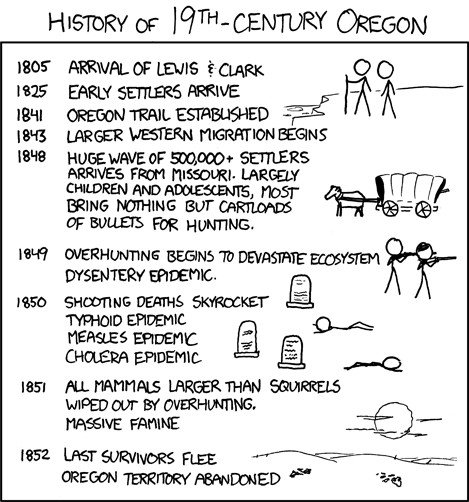
For Everyone Who Ever Died of Dysentery...

Courtesy* of xkcd.

Really, you should read it.


*For 'courtesy,' read: stolen and reposted from...

Tuesday, August 11, 2009

Reciprocity

Generally I refrain from simply reposting another person's expostulations, but today I'm going to make an exception.

I was reading some question and answer forums earlier today when I encountered an interesting question, something that all of us, I think, can relate to. A user, "socrates," asked: "Why is it embarrassing not to have romantic interest reciprocated?"

"I just called a girl from one of my classes, and invited her to lunch on Wednesday. She said yes, but it was clear that she's only interested in friendship. Embarrassed that my romantic interest wasn't reciprocated, I then acted as though I had only meant it as a friendly invitation all along.
This is completely irrational. There's nothing wrong with being attracted to someone, and her lack of interest doesn't mean that I'm somehow inadequate as a person.
So why is revealing a non-reciprocated romantic interest so embarrassing?"

This got me to thinking; what IS all the fuss about? Surely everyone has been in this situation at some point or another, and yet we still allow ourselves to be embarrassed and discouraged by something so ultimately minor. The responses were... varied, as you might imagine, but then I came across a jewel. The user "mendel" cut right to the heart of the issue:

"The general topic you're asking about is what a symbolic-interactionist sociologist would call impression management. (You might recognize the name Erving Goffman, whose book The Presentation of Self in Everyday Life basically addressed the general ideas around the specific case you're wondering about.)
According to the symbolic interactionists, your face (as in "saving face") is the public image you are trying to impress upon others, and in doing so you're actively trying to manage their perceptions about you. As much as you can control this you create a definition of the situation that you try to impose on others (or, at least, have a consensus on).
When you ask a girl out and she imposes her own definition of the situation (friendly lunch, not a date) on yours, all of a sudden your impression management mechanisms fail; you need to create a new face on the fly without letting her know that you're doing so, and also try to make it seem like what you'd done up until that point was consistent with the new definition of the situation.
That's hard to do, and it means that a lot of the bits that make up your public face don't work so well -- you'll say awkward things, stumble on thoughts and speech, and worry that you'd said something before the definition of the situation changed that you can't fit in with the new definition. When that happens, you think that the other people in the conversation see the "real" you instead of the impression you are managing -- you feel like you've lost control over your public face. Everyone does impression management, but no-one wants to admit that they do, and when it's obvious that it's happening it feels like you're missing some important social skills, and I think that's where the embarrassment comes from. It's not socially acceptable to expose your impression management mechanisms but you're afraid you've had to do so when the definition of the situation changed.
(On the other side of the coin, if she's smooth and catches what's going on, she'll let you find your way around the new definition of the situation and ignore any past actions that are incongruent with it, and once the two of you have implicitly agreed on the new situation it feels a lot less embarrassing because you can be engaging in normal impression management again.)"

I know that's a lot to read, especially considering that it didn't come from yours truly, but if you got this far I have to ask: How close did this hit to home?

About Me

My photo
Nick Woll grew up in the Florida Keys, and is furthering himself in the fields of writing, software development, and web design. You can contact him at nwoll27 at gmail dot com.