Showing posts with label history. Show all posts

Sunday, July 18, 2010

Jack Johnson: Oracle?

This is something that's been bothering me for awhile in a big way, and I really need to share it (before anyone else makes the connection).

By now we've all heard about Deepwater Horizon and the oil spill in the Gulf of Mexico. It's about a three hour drive for me to the nearest oil-soaked beach, so it hits pretty close to home, but I'll get to the point: I was listening to a song from Jack Johnson's 2003 album, "On and On," when I realized the lyrics were eerily relevant to the crisis in the gulf.

Have a listen:

Friday, August 14, 2009

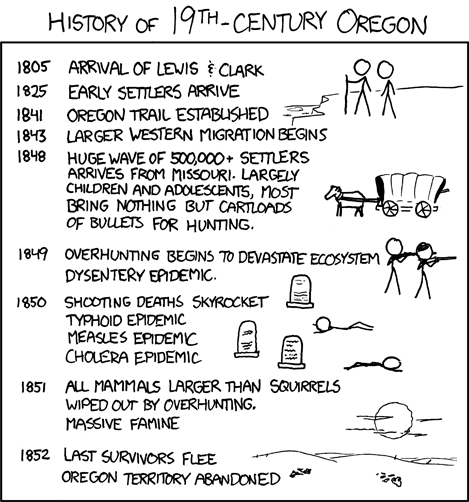
For Everyone Who Ever Died of Dysentery...

Courtesy* of xkcd.

Really, you should read it.


*For 'courtesy,' read: stolen and reposted from...

Wednesday, April 22, 2009

Dancing with an Iron Fist

Following the theme of incredible game trailers, I stumbled across what must be the SECOND best trailer ever created. The lack of a serious budget obviously lends itself to creativity, as is shown in what will likely prove to be a sleeper hit: Stalin vs. Martians.

That's right.

Stalin.

Friday, January 30, 2009

A... Transition?

As anyone who's been paying any attention to their surroundings in the past few weeks can tell you, the inauguration was a heroic victory for all things that are blue. Being frozen for the better part of a day is generally a negative experience, but somehow a million-something of my closest friends managed to overlook our poor decisions and convince ourselves that it was all worthwhile. And it was. And though the actual crowd count may forever remain a mystery, the mass of humanity that filled the mall and seemed to stretch on for eternity was a daunting sight, to say the least. True to my nature, of course, I managed to convince myself that bringing my camera would be a bad idea only to change my mind mere minutes after paying my bus fare, and so I've failed once again to expand this 'hobby' of mine.

Now that I'm back, though, it has come to my attention that my 'photography, writing, and tech blog' has transitioned into a 'political zombie blog,' which is an angle I might pursue as I have resumed work on my Left 4 Dead campaign. With the Beta 0.5 release in two days, I've been hard at work hammering out some of the finer details that I've previously neglected. More on this soon.

Also deserving an honourable mention is the town of Zebulon in North Carolina, because never before have I been so convinced that a small town is inhabited by a race of highly advanced extraterrestrial beings.


Photo actually taken by someone else, in Georgia. Who'd have thought there was more than one?


Now if only I could have seen Jesse Jackson's face when Obama stepped out of his limo...

Thursday, January 15, 2009

Left 4 Inauguration

Well of course, the moment I commit myself to regular blog updates is the moment I become embroiled in a fierce crusade to craft a recreation of my hometown for previously-mentioned zombie murdering masterpiece Left 4 Dead. But I've been remiss, and there's no excuse for it.

Of course, it can't be helped after Sunday, because I'm venturing north to try to get into the District of Columbia before the bridges are closed for the inauguration. No, I wasn't fortunate enough to get tickets to see the big man himself, but I'm just crazy enough to brave the crowds and sub-freezing temperatures anyway.

What all this means is two things: first, that I have every intention of abandoning my post(s) for at least another solid week, and second, that my return will mean a huge content boom for the site. This will be the temporary home for everything involving the development of my Left 4 Dead campaign (tentatively titled Concrete Bayou), including updates, concepts, and development milestones. A number of photography updates should be expected as well.

Also, happy new year, for those who mind. Now, if only I could find a pair of long johns...

Sunday, November 16, 2008

Youtube Videos We Can Believe In

Already, the President-elect is bringing about change in the way our government works. For those who don't remember their history lessons, Franklin Roosevelt made history by circumventing the press and speaking directly to the people via his periodic Fireside Chats. The tradition hasn't died, and while Presidents Kennedy and Reagan mastered the transition to television, Obama is bringing a new act to the table three-quarters of a century later.

For the first time, the President's weekly messages to the public are taped not only for radio broadcast, but for publication on the web. The weekly videos are to be posted on Youtube for easy access by everyone.

The Obama Administration has created a website specifically for the transition into the White House, which you can find here.


Now if only our new President could stop fiddling with his Blackberry.

Tuesday, June 24, 2008

A Legend Passes

This comes a bit late, but I am inclined to make a mention anyway. Many have already heard, but famed comedian George Carlin passed away in Santa Monica, California last Sunday as a result of heart failure. Carlin reveled in his status as a contemporary great, a comedic milestone, and a social philosopher.

His only major regret in life, as stated by himself, was the impact his drug use has had on his daughter. George Carlin's comedy has entertained millions, and his truth has affected many of us. Carlin was 71.

Monday, March 31, 2008

Bush Booed

In what must be an unprecedented event in American history, President George W. Bush was openly booed when he appeared at the Washington Nationals baseball game on Sunday (3/30/08). The President appeared to throw the ceremonial first pitch of the season - a remarkably good pitch, I understand, where Presidents are concerned.


President Bush appears to what could generously be called a mixed reception.

It's remarkable how everyone involved manages to ignore the crowd.

And I thought I wouldn't have anything else to post about this month.

Thursday, February 28, 2008

Barack the Vote

If it isn't entirely apparent from previous posts, I'm a huge supporter of Senator Obama's campaign bid. I'm not the type, however, to argue with every other person over politics or what's right for the nation. At least, not unless there's a great fault in an individual's logic.

It's with that thought that I like to bring to attention the popular argument against the good Senator: experience. For his scrambling opponents, experience seems to be the key issue of this campaign. Experience - or rather, Obama's inexperience - appears to be the prime concern with the coming elections, and voters are being made well aware of this fact. Indeed, one would believe from the constant debates that a lack of experience in the executive branch has never been anything other than disastrous.

It's certainly an interesting argument, especially in the light of history. When experience is paramount, I find it interesting that the single most experienced politician ever to be named Commander in Chief has never been regarded as a spectacular leader. In fact, President James Buchanan has been consistently ranked dead last on the ladder of American Presidency. Conversely, Washington, Jackson, and Truman - some of the most renowned presidents in American history - had almost no real experience to speak of. Even Lincoln, the Great Emancipator himself, never attended college.

And let's not forget, nobody had a longer curriculum vitæ than Cheney or Rumsfeld.

In related news, Black Eyed Peas frontman Will.i.am, in conjunction with director Jesse Dylan, produced a rather inspirational music video promoting Senator Obama's campaign. The song is written almost entirely using excerpts from Obama's speeches, and is called "Yes We Can."

Wednesday, December 5, 2007

December 5th is Repeal Day!

December 5, 1933 was the day that state conventions ratified the Twenty-First Amendment to the U.S. Constitution. The amendment repealed the Eighteenth Amendment, effectively ending prohibition and becoming the first and only amendment to constitutionalize a pleasurable activity. Jeffrey Morgenthaler has long been an advocate of officializing the celebration of Repeal Day, and it seems that Dewar's Scotch Whiskey has taken a shining to the idea as well.


Celebrate Repeal Day!

Monday, December 3, 2007

Fiscal Year '0X - The Brain Drain

Poor spending seems to be one of the many recurring themes of the Bush Administration, and striking a balance between the departments of Defense and Education is precisely what many critics suggest. But how many Americans actually know where their taxes are going? What exactly is this great disparity that has so severely burdened Bush's budget?

I took the time to peruse through some of our nation's spending habits and found some interesting information. The gap between the cost of war and our investment in knowledge isn't just large, it's unnerving. In 2006, the United States government spent nearly $500 billion in national defense, while only $93.4 billion was invested in education; and that was high. In 2005, $72 billion was spent on education, and the 2007 budget granted the Department of Education only $68 billion. Between 2004 and today, the US has spent over $1.95 trillion on defense. Comparitively, the Department of Education has recieved less than $300 billion.

In all fairness, the Department of Defense is not quite the fattest agency on the books. By year's end, the 2007 budget will encompass expenditures of over $671 billion on health and human services alone, a substantial increase from the $581 billion spent in 2005; impressive figures for a worthy cause. It seems odd, then, that nearly 47 million Americans (16%) were without health insurance in 2005. Odd, too, that this number was about 1.3 million higher than the year before it, despite a $40 billion budget increase.

In 2004, despite a record voter turnout, only 58% of Americans aged 18-24 were registered to vote. In the same category, only 47% actually voted, the lowest category by far. Based on these numbers, it would seem that young Americans are uncaring, uneducated, or otherwised discouraged from taking part in arguably the most important aspect of American Government.

What does all this mean? My guess is as good as anyone's, but it seems that the correlation between the ignorance of politics in American schools and an ailing education budget may be more than coincidental. If anything will help politicians desperately cling to a conservative platform, a collective brain drain will do it.

Wednesday, November 28, 2007

Obama: The End of a Headache

Tuesday night marked the end of my English course. Sure, I'll still be attending for several weeks, but I turned in my final paper for review, and the only reason to attend class at this point is the several remaining grammar tests.

This is good news, because now, hopefully, I will be able to devote more time to my own projects. In the meantime, check out my fairly biased dissertation on Barack Obama.


It was only two centuries ago that a band of colonies declared its sovereignty from Great Britain. This, the formation of the United States of America, would be a catalyst for change throughout much of Western society. In an era dominated primarily by monarchial societies, the emergence of democracy in the New World gradually became a beacon for the downtrodden. For the first time in centuries, people had a voice, if only a small one; and immigrants eventually came to the United States in droves, in search of better lives. It was the inherent liberalism in this form of government that paved the way for the freedoms we now know, and which provided the groundwork for the global powerhouse that we are today. Given the right leadership, democracy allowed the country to flourish, but in the past eight years, the United States has witnessed a decline in economics, civil liberties, and foreign relations. Since the beginning of 2001, the Bush Administration has overseen all of these changes and has been instrumental in obstructing the nation’s progress as a whole. Now, as 2007 draws to a close, it is evident that the coming elections are to be among the most momentous in recent memory, with consequences inherent not for just the United States, but for the entire world. With the primary elections drawing near, one thing is clear. America needs a leader who can unite the people, who can remain true to his ideals in the face of adversity, who has continually displayed perseverance and success in the face of great obstacles, and who can be the voice of change for the American people; Barack Obama is that leader.

Born in Honolulu, Hawaii in 1961, Barack Obama was a child of diverse parentage. His father, a foreign student from Kenya, separated from his mother, a middle class Kansan woman, when he was only two. His mother later married Lolo Soetoro, with whom she moved to Jakarta, Indonesia, where Obama attended school from the ages of six to ten before returning to Hawaii to live with his maternal grandparents. Because of the difficulties of his childhood and the hardships he faced in his early life, Obama has developed a set of beliefs and ideals that revolves around a strong sense of right and wrong on a global scale. This attitude has allowed him to succeed, first as a member of the community, and now as the incumbent senator of the state of Illinois.


It is this same attitude, this sense of justice, which accounts for what is perhaps Obama’s strongest suit. After two terms of controversy and fear driven policy, what the United States needs now more than ever is a leader who can unite the populace. Never in recent years has a presidential candidate so successfully rallied people behind him. He garners this support through fairness and reason, making certain to view issues from every possible perspective before passing judgement, and taking the well being of his fellow citizens into consideration before every momentous decision. In interviews, Obama is an everyman, speaking at ease and making connections through words and observations with everyone whom he comes in contact with. Through his actions and his beliefs, Barack Obama has single-handedly unified thousands of Americans of every race and creed. No other candidate has shown great enough success to rival the rapidly growing grassroots movement which has inspired Americans from every demographic to band together in support of one common cause.


As an individual, Barack Obama has proven himself to be absolutely resolute in his principles. As the first candidate in memory to reject the promise of campaign contributions from lobbyists and special interest groups, Obama has relied on the grassroots movement to be the core of his campaign. Within the first nine months, Obama raised over 58 million dollars – more than any other presidential candidate in history – from 365,000 individual contributors, none of which came from Washington lobbies.

While he is by no means the first candidate with religious ties, Obama is unique in that he speaks openly on faith and the importance of diversity in beliefs. In a realm where religion is often controversial, Obama draws from his faith to support his cause. He stands by his belief, but admits the doubts and uncertainties of religion. He draws strength and balance from faith and speaks with a fervor almost reminiscent of Martin Luther King, but allows only reason to be his sovereign.

Also indicative of Obama’s resolve is his voting record. While many candidates have voted dubiously on issues in reaction to pressure or popularity, Obama has remained true to his own beliefs on the ballot. In his time as a senator, he has established a steadfast voting record to support his views despite outside pressure. From the beginning, Obama has opposed the war in Iraq, and his voting record has firmly reflected this view. From the initial decision to go to war to a more recent bill which would have called for an increase in funding for the Department of Defense, he has voted decisively to prevent and reduce military deployment. Conversely, his support for more humanitarian efforts has shown in the endorsement of improvements to the Children’s Health Insurance Program and the restoration of habeas corpus for detainees of the United States. Barack Obama is a man of principle who acts upon his ideals, but is not ruled by them; he values honesty, both to himself and to others; and he stands as a pillar for the American people.


With his remarkable moral fortitude and his conscientious approach to issues, it’s not surprising that Obama is well suited as a legislator. Having been instilled by his mother with what can only be described as hard-working Midwestern values, Obama gained much of his initial experience in politics in the mid 1980's, when he became a community organizer for a church-based group in Chicago. It was here that he realized that in order to make true changes in the lives of people in communities all over the nation, he would need to make changes in the lawmaking and political process.

After he earned his degree from Harvard University in 1991, where he became the first African-American president of the Harvard Law Review, Obama returned to Chicago, where his advocacy work led to his eventual election to the Illinois State Senate. In 2004, after eight years as Senator of Illinois, Barack Obama became the third African American to be elected to the U.S. Senate. His time prior to his entry into politics as a civil rights lawyer and an instructor in constitutional law has left Obama well equipped to make progressive changes, and eleven years in politics has served as preparation to take the stand as the leader of the United States of America.


Obama’s entire campaign is representative of a change in the way America governs. By far one of the most ambitious and progressive candidates in years, Obama aims to improve the broken health care system, providing universal health care to all Americans; he understands the importance of protecting the Earth's climate, and is an advocate of alternative energy; he has plans for educational reform, with plans to raise the salaries of teachers and close the learning gap; he aims to restore and protect the American right to vote, making significant election reforms to prevent abuse; and he will continue to strive towards the reconciliation of faith and politics, with the intent of reducing hostilities between those of different faiths. He will be a pioneer for a new kind of Presidency.

At the age of 46, Obama will be among the youngest of American presidents, bringing a much-needed youthfulness to office. Also, even before the primary elections, an African-American campaigning for President of the United States has caused a stir around the world. Were Obama to be elected, it would represent the great leaps and strides that we have made as a nation towards equality, and – more importantly – his success would open the doors for future diversity in office. Obama’s unique standing as a candidate and his honest, progressive goals have captured the hearts of hundreds of thousands of Americans; and for the first time in decades, the youth of America have found inspiration to participate in politics.


The United States of America is a nation founded on freedom, equality, and choice. Over the past two hundred years, these foundations have been built upon and reinforced, but the Bush Administration has dealt a serious blow to that progress. Over the past seven years America has seen its economy plummet, its diplomacy fail, and its freedom maimed; it has seen war and, worse yet, its people have been divided. It is a critical moment in the history of America and the world, and ours is a country in desperate need of change. As a nominee, Barack Obama has the potential to be that change. He is a symbol of progress, a catalyst for change. In a time of division in a land of unity, Obama is a leader who can unite the nation. Never before has our fate been so clear: America needs a leader who can reunite the divided people, a leader who will remain moral and just in the face of immense adversity and who will persevere and thrive in the face of great obstacles. America needs a leader who will be the voice of change for Americans everywhere. Barack Obama is that leader.

Thursday, October 18, 2007

So It Goes

The last few weeks have been... interesting, to say the least. Concerning my writing, class was canceled the week of Columbus Day on Tuesday (which was Leif Erikson Day, oddly enough). I did manage to churn out my usual essays despite an awful case of writer's block, none of which are interesting enough to share.


What I will share, however, is a recommendation. When I wrote my original essay last week I also had to write, as per the usual, a companion summary of a text from our reference books. I instantly decided on a short story from the late Kurt Vonnegut, a wonderful little dystopian romp called "Harrison Bergeron" describing a future egalitarian society taken to extremes. The story can be found in it's entirety here.

Wednesday, October 3, 2007

Civilization - Example

I was at a loss last weekend when I realized I needed to come up with a topic for Tuesday's essay, so I considered myself lucky when a friend of mine began telling me about his own writing assignment on human civilization. I decided that I was out of ideas, and I took civilization and ran with it. It might be worth noting now that I use "Civilization" intentionally as a physical object, and so as a proper noun.

---

Since humanity first climbed from the clutches of its primordial hovel, it has sown the seeds of creation. It has striven to master its own world, to triumph over itself, and to rise to yet greater ingenuity. Mankind's greatest achievement is the Civilization, a complex system of agriculture and labour divisions contained within an intricate evolution of mankind's total social heredity. Yet, mankind's greatest talent is not creation, but destruction. It is fitting, then, that the nature of the Civilization is that of the phoenix, and that from smoldering ash arises a new era for mankind to bask in his own glory; for the Civilization is not merely a collection of farms and social ranks, it is a cage in which lies the brutal savagery inherent in the race of man.

Even in Sumer, the cradle of civilization, is this aggression evident. The great cities that birthed writing, astronomy, arithmetic, legal systems, the calendar, and the wheel laid siege to themselves and fell to obscurity as they were annexed by another rising power. Two thousand years later along the banks of the river Tiber the great Roman Empire raised the Colosseum, a grandiose achievement in architecture and engineering devoted to the entertainment of man through spectacles of bloodshed and battle. A full millennium later on a continent halfway around the world the Aztecs erected the first Great Temple, a man-made mountain paying tribute to Tlaloc and Huitzilopochtli, the gods of rain and fire. For days on end, human sacrifices would be conducted atop the great pyramid, and the bodies would be cast down the steep sides to pile at the base of the sacred grounds. This civilization, like all others before it, eroded itself from within only to be devoured by another larger, more destructive culture.

Six thousand years have passed since humanity first ascended from its cradle, and little has emerged to keep its brutality in check. Even today, so-called "humanitarian" efforts against mankind's nature uniformly fail to prevent sectarian bloodshed across the globe. In more "refined" societies around the world, violence is siphoned away from its homeland through war, only to fuel more destruction. Often, even the prospects of war and administrative action fail to completely stifle a population's violent tendencies as crime runs rampant in urban areas. Not even the impending depletion of resources could manage to abate mankind's thirst for the blood of his own; rather, it has thrown him into a panic and further stimulated his aggression. Modern civilization has no Colosseums, no warlords, and no sacrificial temples; the hunger of the populace is stymied only by rigorous regimes of violent media. Humanity has found not a way to tame its brutality, but to divert it with technology, effectively moving the gladiator from the arena to the television screen.

From the construction of the first ziggurat to the launching of the first space shuttle, mankind has struggled to contain his aggression, to move forward unhindered by his savage tendencies. Instead, he has merely set it aside, channeling his talent through his rage in order to create. The fatal flaw in the Civilization lies here, in that humanity does not overcome its brutality insomuch as it harnesses it as impetus for growth, encouraging mankind's killer instinct to grow and elevating itself higher still to create, eventually, a destructive force well beyond imagination. It is the self-destructive aspect of the Civilization that is imperative to its remarkable ability to renew itself. Like the phoenix, the Civilization will crumble with age and fall to fire, only to emerge from the ashes anew and stronger than before. Even so, all things must come to an end, and the question must be asked: can the ultimate destruction of humanity's greatest invention be deterred; or will the Civilization at last collapse - as it has so many times before - once and for all?

---

About Me

My photo
Nick Woll grew up in the Florida Keys, and is furthering himself in the fields of writing, software development, and web design. You can contact him at nwoll27 at gmail dot com.